Software architecture influences how quickly a business can change, what it costs to operate, and which options remain available later.
Software architecture is often discussed in technical terms: services, databases, APIs, deployment models, frameworks and system boundaries. But these decisions have business consequences. They affect time to market, the cost of change, reliability, team independence and the risks an organisation accepts as its product evolves.
Consider a company preparing to launch a new customer platform.
The initial requirements are relatively simple. The product will serve one market, support one product line and be developed by a small engineering team. The commercial objective is to launch within six months, learn from real customers and expand if the product proves successful.
The team could build a relatively simple application and optimise for delivery speed. It could also introduce independently deployable services, asynchronous messaging, multiple data stores and infrastructure designed for the scale the business expects to reach later.
Both approaches can be technically valid. The important question is which set of trade-offs supports what the business is actually trying to achieve.
Architecture does not only determine how software is built. It determines how easily the business can change direction once that software is in production.
Start with business constraints
Architecture discussions often begin with a solution.
Should the system use microservices? Should it be event-driven? Should every service own its own database? Which cloud platform should the team use?
These can all become useful questions, but they are rarely the best place to start. A stronger architecture discussion begins with constraints:
How quickly must the product launch?
How many teams will work on it?
Which parts of the system are expected to change frequently?
How much downtime can the business tolerate?
Are there regulatory or data-residency requirements?
Does the organisation already have the skills required to operate the proposed architecture?
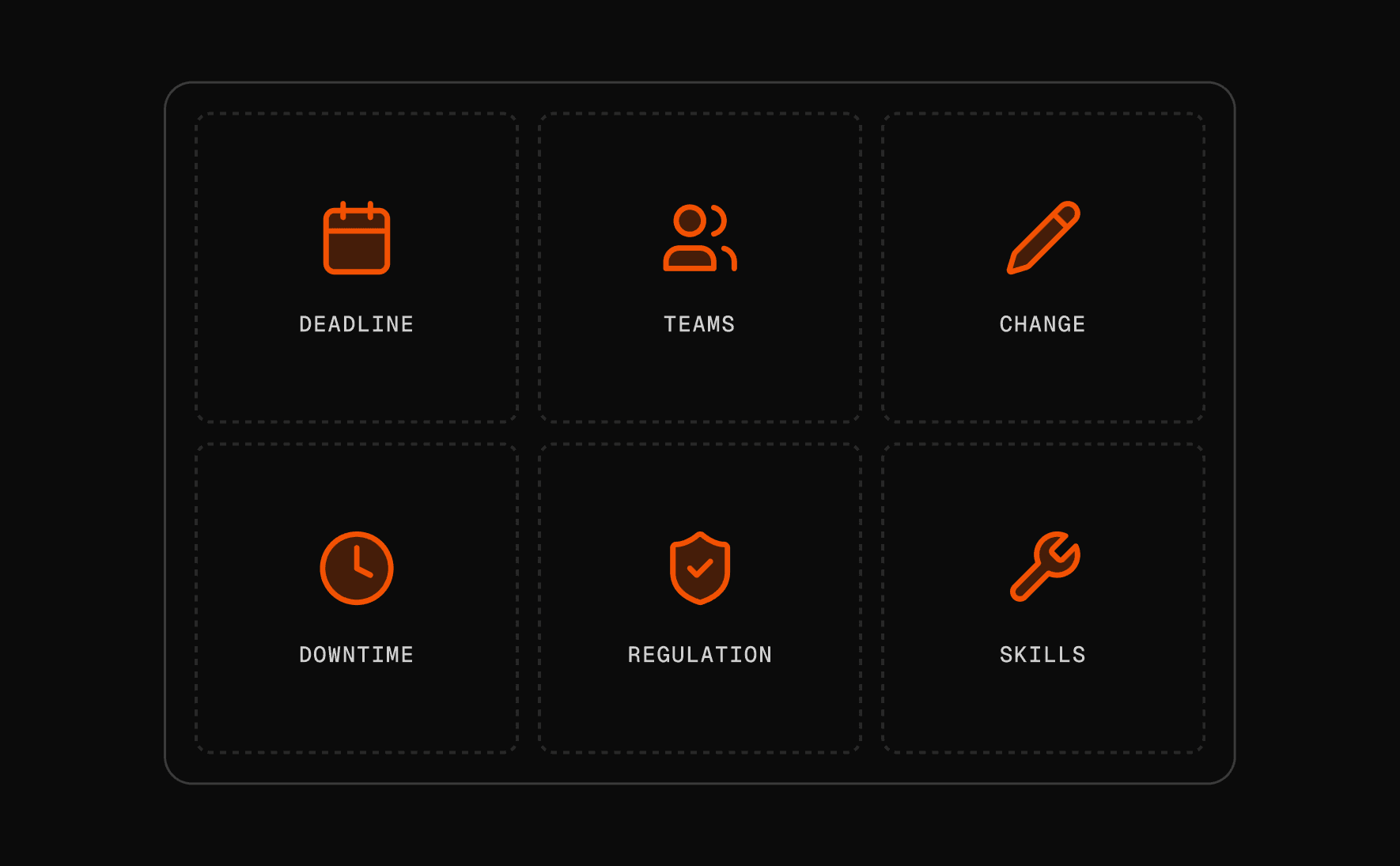
Those answers change what a good architecture looks like.
For the customer platform, a six-month deadline and one small delivery team may favour a modular application with clear internal boundaries and a straightforward deployment model. The business gets to market quickly without taking on the operational overhead of several independently deployed services.
That does not make the architecture unsophisticated. It means the architecture reflects the current business constraints.
Now change the scenario. Suppose the platform must launch in several regulated markets, process sensitive customer information and support multiple teams that need to release independently. Stronger technical boundaries may become valuable enough to justify their additional cost.
The architecture changes because the business context changes.
Cost is another constraint that can disappear behind technical terminology. More services can mean more deployment pipelines, environments, monitoring, infrastructure and operational knowledge. Those are not only engineering concerns. They create recurring commitments that the organisation needs to fund.
Complexity is therefore not evidence of architectural maturity. Sometimes the more mature decision is to choose the simpler system because the business does not yet need the capabilities that would justify greater complexity.
A pattern is useful when it addresses a business constraint. That constraint should guide the choice.
Explore Glucode’s approach to software engineering, including architecture, technology selection and delivery.
Delivery speed today can increase the cost of change
Every architecture optimises for something.
A tightly integrated system can be fast to build because there are fewer moving parts. One team may be able to understand the whole product, make a change and deploy it without coordinating several services.
For an early product, that can be an excellent business decision. The trade-off appears later if the product succeeds.
Imagine that the customer platform expands into several markets. Billing rules now differ by country. New integrations are introduced. Several teams contribute to the same codebase. A change to one feature increasingly affects unrelated parts of the system.
The architecture that helped the business move quickly at the beginning can start increasing the cost of every future change.
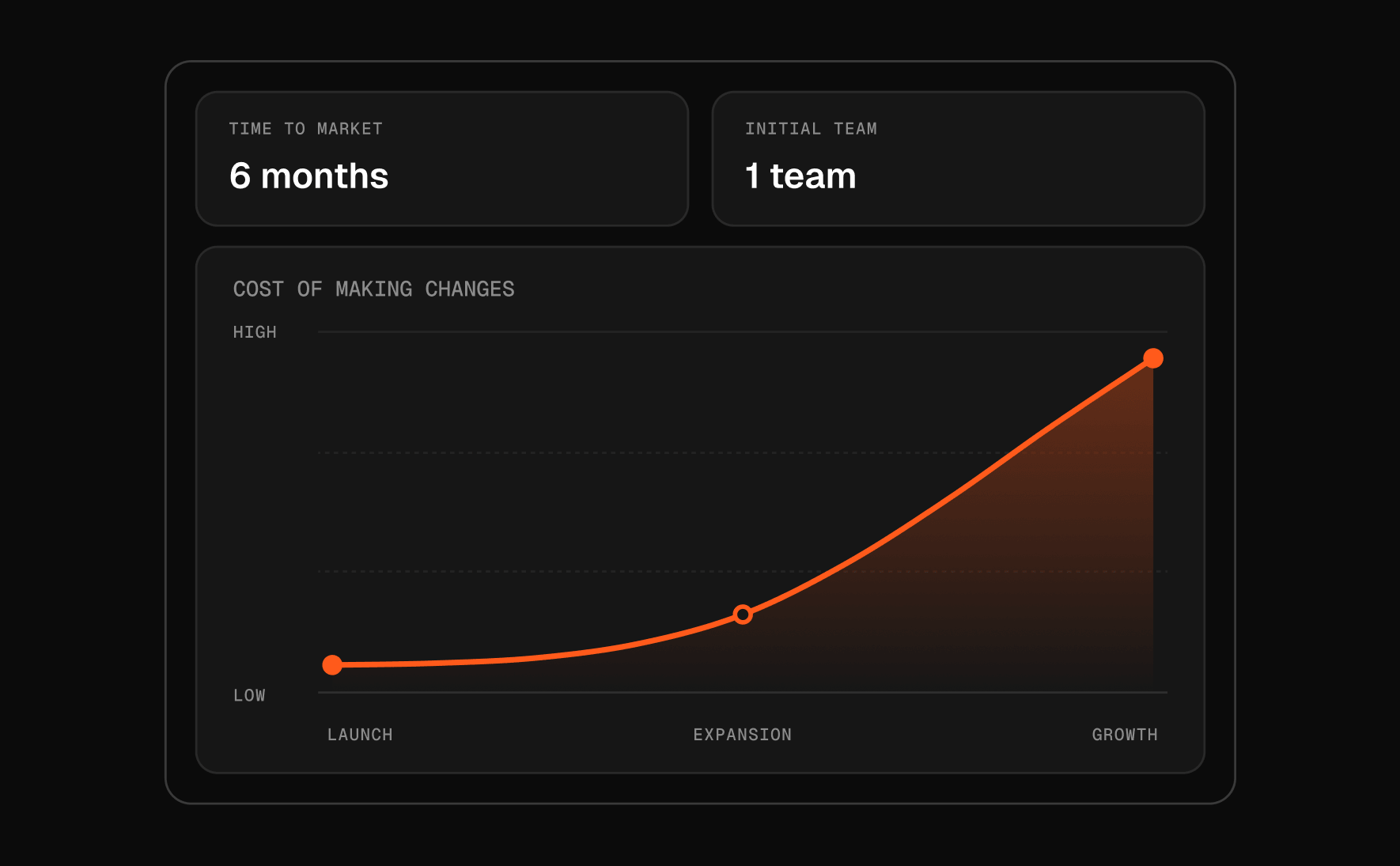
The opposite trade-off also exists. The team could have introduced several services, asynchronous messaging, independent deployment pipelines and separate data ownership from the beginning. That might make some future changes easier to isolate.
But the business would have started paying for that flexibility immediately. Engineers would need to manage distributed tracing, service-to-service communication, deployment coordination, eventual consistency, additional infrastructure and more complicated failure scenarios before the product had demonstrated that it needed them.
This is why “future-proofing” can be misleading. Software cannot realistically be designed for every possible future. Trying to do so often means spending today’s engineering budget on problems the business may never face.
The goal is not to avoid architectural change forever. Instead, ask: which future changes are likely enough, and expensive enough, that preserving flexibility is worth paying for now?
Part of architectural judgement is deciding where the benefits of complexity justify its cost.
Architectural flexibility has a price
Good architecture preserves useful options, but every option carries a cost.
Consider payment processing. The customer platform could integrate directly with one payment provider wherever payment behaviour is required. That may be the quickest way to launch.
Alternatively, the team could introduce an internal payment boundary. Product code would depend on that boundary rather than directly on the provider, while provider-specific behaviour sits behind it.
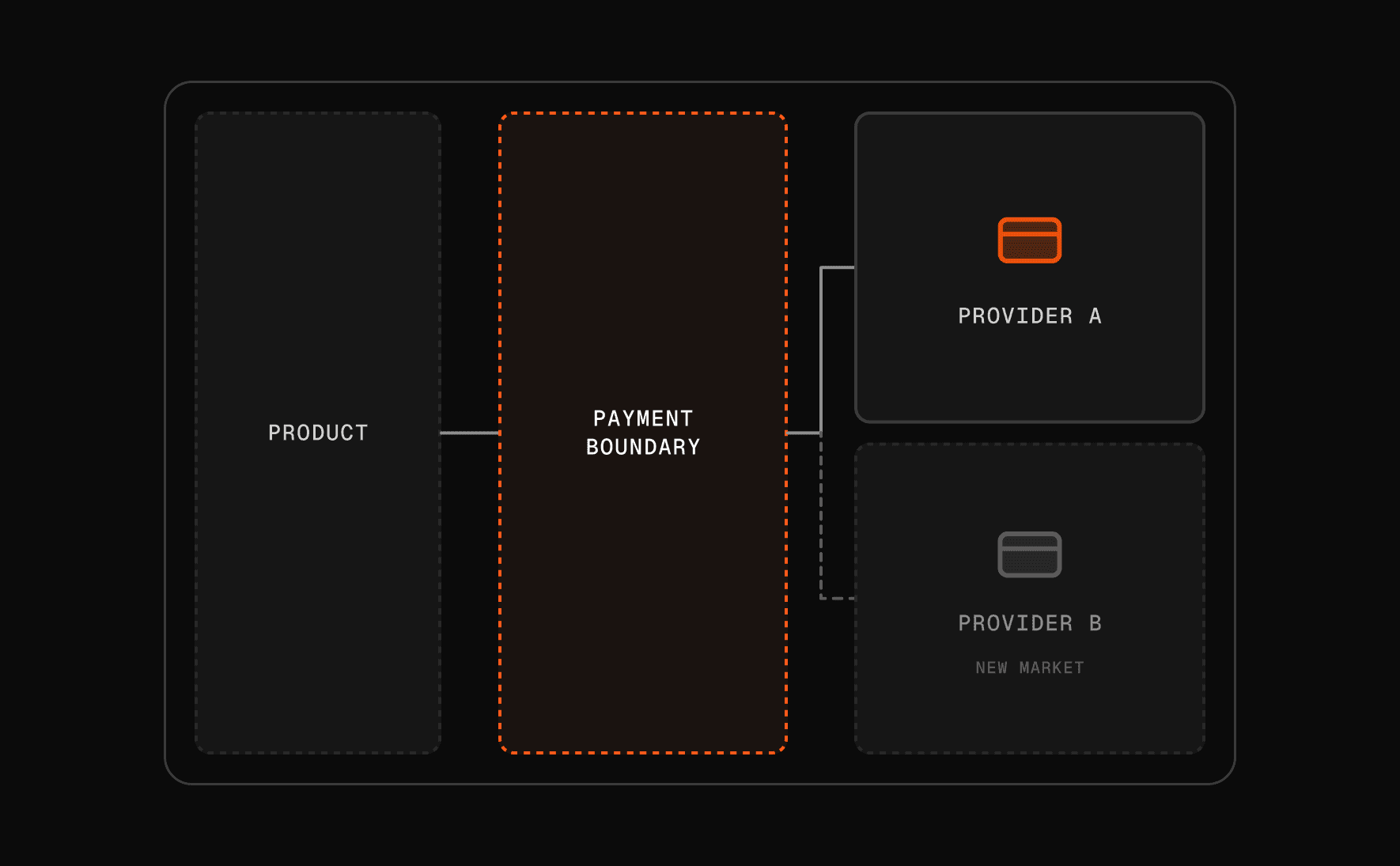
The second approach requires more design today. But suppose the business plans to expand into markets where the original payment provider does not operate. The ability to introduce another provider without rewriting payment behaviour throughout the product becomes valuable.
In that case, the abstraction is not simply a clean-code preference. It protects a business option.
If the company has a long-term agreement with one provider and no credible reason to replace it, the same abstraction may provide much less value. The reasoning applies to authentication platforms, cloud providers, data stores and third-party services.
Teams sometimes attempt to abstract everything because the underlying technology might change one day. That flexibility is not free. Every abstraction introduces another concept engineers need to understand, test and maintain.
Every additional service creates infrastructure and operational responsibilities. Every layer intended to protect against future change has a cost today.
Architecture should preserve flexibility where the business has a credible reason to need it, rather than maximise flexibility everywhere.
How architecture affects operational risk
Architecture shapes how failures spread and how much of the product they affect.
Imagine the customer platform depends on an identity system and a billing system. If identity is unavailable, customers may be unable to access the product at all. A billing outage could have a different effect: existing customers might continue using the product while payment operations are retried later.
These failures have different business consequences, which should influence the architecture. A critical dependency may need stronger redundancy, monitoring and recovery mechanisms. A less time-sensitive process may benefit from asynchronous processing and retries rather than blocking the customer journey.
The same reasoning applies to data. If information is distributed across several services, what happens when one update succeeds and another fails?
Does the operation roll back?
Can it safely be retried?
How does the system recognise that it is in an inconsistent state?
How quickly does the business need to recover?
Architecture determines which of those problems the organisation will need to solve.

A single deployable application may have a larger failure domain, but deployment and rollback can be straightforward. A distributed system can isolate certain failures, but diagnosing an incident may involve networks, queues, retries and multiple independent services.
Neither model is automatically safer.
The business needs to decide which risks are important enough to justify the complexity required to reduce them.
Reliability has direct business consequences. Downtime affects revenue. Failed transactions affect support teams. Lost or inconsistent data damages customer trust. Slow recovery increases the cost of incidents.
Architecture determines how much the organisation must invest to manage those outcomes.
How architecture shapes team coordination
Architecture creates technical boundaries and shapes how teams need to communicate and coordinate.
Suppose three teams regularly change the same tightly coupled part of the customer platform. A feature owned by one team may require coordination with the other two before it can be released. The technical dependency becomes an organisational dependency.
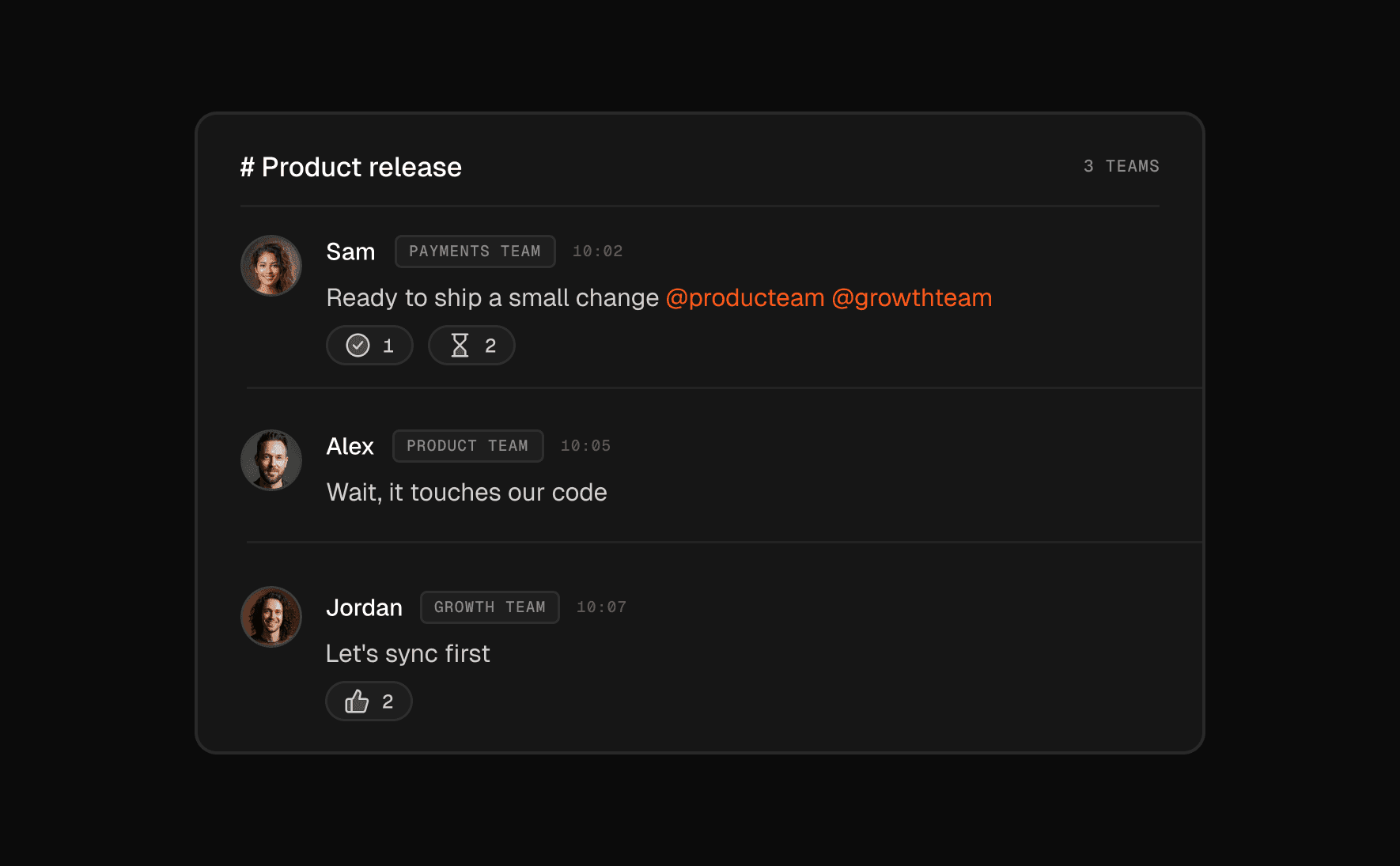
Clearer boundaries can allow teams to take ownership of specific capabilities and make changes with less coordination.
That does not mean every team should receive its own micro-service. A small engineering team can often move faster with fewer deployment units and well-defined modules within the same application. Creating a distributed system simply to mirror an organisation chart can add complexity without giving teams meaningful independence.
As the organisation grows, areas with genuinely different ownership, deployment requirements or operating characteristics may benefit from stronger separation.
Architecture should therefore be revisited when the organisation’s size, structure or team responsibilities change significantly.
The cost of coordination is easy to miss on an architecture diagram, but it can become one of the largest costs in software delivery. Architecture influences who needs to speak to whom before a change can reach production.
A Case of App Sprawl explores the costs of disconnected applications and decisions made without a shared roadmap.
Make architectural trade-offs explicit
There is no universally correct software architecture. The right choice depends on the product, the organisation and the constraints surrounding both.
Architecture reviews become more useful when the discussion moves away from whether a particular pattern is considered modern and towards the consequences of adopting it.
Architecture decision checklist
Before committing to an architectural direction, check whether the team can answer the following questions clearly:

Business outcome: What business objective is this architecture intended to support?
Current constraints: What deadlines, budget, regulatory requirements, team structure and operational limits matter today?
Expected change: Which parts of the product or business are most likely to change over the next few years?
Cost of being wrong: What happens if the assumptions behind this design turn out to be incorrect?
Complexity introduced: What infrastructure, abstractions, dependencies or operational responsibilities are being added now?
Future flexibility: Which likely future change would this design make easier or less expensive?
Failure behaviour: What happens when a critical component or dependency becomes unavailable?
Recovery: How will the system detect, isolate and recover from failure?
Data ownership: Is it clear which component owns important data and how consistency is maintained?
Security and compliance: Does the architecture support the required access controls, privacy obligations and regulatory constraints?
Team ownership: Is it clear who owns, changes and supports each important part of the system?
Operational capability: Does the organisation have the skills and capacity to deploy, monitor and maintain the design?
Reversibility: How difficult would it be to change this decision later?
Evidence: Which measurements, prototypes, incidents or known requirements justify introducing the additional complexity?
Not every architectural decision needs an exhaustive review. A small, reversible choice may need only a short discussion. A decision affecting core data, multiple teams or long-term infrastructure deserves stronger evidence and closer review.
The objective is to make the reasoning visible.
Choosing a simple architecture because speed to market matters more than future flexibility can be a sound decision. Choosing more separation because regulatory requirements or independent team ownership justify the operational cost can also be a sound decision.
Problems arise when those trade-offs remain implicit. A team adopts microservices because it expects to scale, without checking whether independent deployment is needed. Another adds an abstraction for a possible provider change, without assessing how likely that change is. Another chooses tight coupling for delivery speed, without considering the cost of later changes.
Each choice may be reasonable. Engineering judgement lies in connecting the technical decision to the assumption behind it and understanding what happens if that assumption changes.
Architecture is the shape of future choices
The best architecture is not the one with the most services, the most abstraction or the most sophisticated infrastructure. It is the one whose trade-offs match the product and business strategy.
Some businesses need to optimise aggressively for speed. Others need strong isolation, reliability or regulatory control from the beginning. Some need to preserve the ability to replace providers or enter new markets. Others would gain little from paying for those options before they are needed.
Those differences should shape the architecture. Technical decisions determine how software behaves today, but they also influence how expensive tomorrow’s decisions will be.
That is why software architecture is both an engineering concern and a business decision.
Working through architectural decisions for your product? Talk to Glucode about your project.